

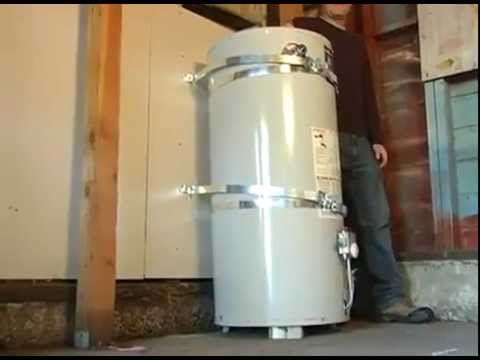
California has statewide requirements that go beyond what most other states enforce. Los Angeles homeowners are subject to all of them, plus local South Coast AQMD emissions rules that affect which units are even available for purchase in this region.
Seismic Strapping — Required by State Law
Since 1991, California law has required all new and replacement water heaters to be seismically braced. The requirement applies statewide and is enforced at inspection on every permitted replacement job.
A compliant installation requires two heavy-duty steel straps — one positioned in the upper third of the tank, one in the lower third — anchored securely to wall studs or masonry. Each strap must encircle at least 80% of the tank’s circumference. For units larger than 52 gallons, additional straps are required.
If you’re selling a home in California, you are required to certify in writing that your water heater has been properly strapped. An unstrapped or improperly strapped unit needs to be corrected before close of escrow.
Low-NOx Emissions Requirements — SCAQMD Rule 1146.2
The South Coast Air Quality Management District (SCAQMD) enforces strict emissions limits on gas appliances sold and installed in Los Angeles, Orange, Riverside, and San Bernardino counties. Under SCAQMD Rule 1146.2, residential gas water heaters must meet low-NOx or ultra-low-NOx emissions standards.
In practical terms, this means not every water heater sold nationally is available for installation in Los Angeles. Units must carry SCAQMD certification. A licensed local plumber will know which units are compliant — an unlicensed installer or an out-of-area purchase may not.
Starting January 1, 2026, zero-emission standards are phasing in for new construction. For existing home replacements, low-NOx units remain the standard, but the regulatory direction in California is clearly toward heat pump water heaters over time.
Permits Are Required
A permit is required for water heater replacement in Los Angeles, La Habra, and Anaheim. The installation must be performed by a licensed contractor, and the work must be inspected. A job done without a permit creates liability at resale, may void the manufacturer’s warranty, and is not a compliant installation regardless of how well it was done.
A reputable installer will pull the permit as part of the job. If a contractor offers to skip the permit to save money, that’s a red flag.
