

Los Angeles tap water is technically safe to drink. LADWP tests for over 100 contaminants and meets all federal and California Maximum Contaminant Level standards. That’s the official answer, and it’s accurate.
But “within legal limits” and “as clean as you might want it to be” are two different things. LA’s water has well-documented characteristics — hard water mineral content, chloramine disinfectants, PFAS, and contaminants that exceed state health goals even when they fall below the legal enforcement threshold — that lead a large number of homeowners to filter their water at home.
This guide covers what’s actually in Los Angeles water, which filtration systems address which concerns, and what installation looks like for homeowners in Los Angeles, La Habra, and Anaheim.
What’s in Los Angeles Tap Water
LA’s water is drawn from multiple sources: the Los Angeles Aqueduct (fed from the Eastern Sierra), the Colorado River Aqueduct, Northern California’s State Water Project, and local groundwater basins in the San Fernando Valley. Each source has its own contaminant profile, and the blend changes with drought conditions and seasonal supply shifts.
The contaminants most relevant to homeowners fall into a few categories:
Hard Water Minerals
Southern California water is hard — high in calcium and magnesium. This is the most universally felt water quality issue in the LA area. Hard water leaves scale deposits on fixtures, inside appliances, and inside pipes over time. It reduces the efficiency and lifespan of water heaters, dishwashers, and washing machines. It’s also the reason LA homeowners deal with soap scum, spotted glassware, and dry skin and hair after showering.
Hard water isn’t a health concern, but its effect on plumbing and appliances is real and cumulative. Scale buildup inside a water heater tank is one of the primary reasons units in LA fail earlier than their rated lifespan.
Chloramine Disinfection Byproducts
LADWP uses chloramine — a combination of chlorine and ammonia — to disinfect the water supply. Chloramine is more stable than chlorine alone, which makes it effective for a large, complex distribution system like LA’s. The tradeoff is taste and odor: many homeowners notice a chemical smell or flat taste that they correctly attribute to the disinfectant.
Chloramine also reacts with organic matter in water to form disinfection byproducts, including trihalomethanes (TTHMs) and haloacetic acids. LADWP’s levels are within the legal thresholds, but they are present. Standard carbon filters remove chlorine but are less effective on chloramine — catalytic activated carbon is the correct filter media for chloramine removal.
PFAS (“Forever Chemicals”)
PFAS — per- and polyfluoroalkyl substances — are a class of synthetic chemicals that don’t break down in the environment or in the human body. They’ve been linked to cancer, hormone disruption, and immune system effects. PFAS have been detected in LA’s water supply, primarily from groundwater sources.
California has adopted some of the strictest PFAS standards in the country, and LADWP actively monitors and treats for these contaminants. However, because PFAS regulations and detection methods are still evolving, many homeowners in LA choose to install filtration that addresses PFAS as a precaution. Reverse osmosis systems are the most effective at-home solution for PFAS removal.
Chromium-6 and Arsenic
Both chromium-6 and arsenic occur naturally in California’s groundwater and are present in LA’s water supply at levels that, while below federal Maximum Contaminant Levels, exceed California’s more protective Public Health Goals. The EWG’s 2025 analysis found chromium-6 in LA’s water at levels exceeding its health-based guideline, and arsenic similarly below the legal limit but above the state’s health goal.
For most healthy adults, these levels represent a low risk. For households with infants, pregnant residents, or immunocompromised individuals, the gap between “legal” and “optimal” is worth addressing. Reverse osmosis removes both effectively.
Lead from Household Plumbing
LADWP completed its lead service line inventory in 2024 and determined there are no lead service lines in its distribution system. That’s good news. The remaining risk is from household plumbing — specifically older homes with lead solder in their internal pipe connections. Lead doesn’t come from the water source; it leaches into water as it sits in older plumbing.
If your home was built before 1986, a point-of-use filter at the kitchen tap — or a whole-home system with lead reduction capability — is a reasonable precaution.
A-1 Total Service Plumbing installs water filtration systems throughout Los Angeles, La Habra, and Anaheim. Call us to discuss which system is right for your home.
Water Filtration Options for LA Homeowners
There is no single “best” water filtration system — the right choice depends on which concerns you’re trying to address, your home’s size, and your budget. Here are the main options, with honest notes on what each does and doesn’t address.
Whole-House Water Softeners
A water softener uses an ion exchange process to replace the calcium and magnesium ions that cause hardness with sodium ions. The result is soft water throughout the entire home — at every tap, appliance, and fixture.
What it addresses: Hard water scale, appliance wear, dry skin and hair, soap scum, spotted dishes and glassware.
What it doesn’t address: Chloramine taste and odor, PFAS, chromium-6, arsenic, or lead. A softener is a hardness solution, not a comprehensive contaminant filter.
Note for LA homeowners: Some municipalities in Southern California have restrictions on water softener discharges due to the sodium load they add to the wastewater system. Check with your local water agency before installing. La Habra and Anaheim fall under Orange County Sanitation District jurisdiction; Los Angeles has its own wastewater authority. A licensed plumber can advise on current requirements.
Whole-House Carbon Filtration
A water softener uses an ion exchange process to replace the calcium and magnesium ions that cause hardness with sodium ions. The result is soft water throughout the entire home — at every tap, appliance, and fixture.
What it addresses: Hard water scale, appliance wear, dry skin and hair, soap scum, spotted dishes and glassware.
What it doesn’t address: Chloramine taste and odor, PFAS, chromium-6, arsenic, or lead. A softener is a hardness solution, not a comprehensive contaminant filter.
Note for LA homeowners: Some municipalities in Southern California have restrictions on water softener discharges due to the sodium load they add to the wastewater system. Check with your local water agency before installing. La Habra and Anaheim fall under Orange County Sanitation District jurisdiction; Los Angeles has its own wastewater authority. A licensed plumber can advise on current requirements.
Whole-House Carbon Filtration
A whole-house carbon filter is installed on the main water line and treats all water entering the home. Carbon media adsorbs chlorine, chloramine (with catalytic carbon), and many volatile organic compounds (VOCs), improving taste and odor at every tap.
What it addresses: Chloramine and chlorine taste and odor, VOCs, some pesticides and herbicides.
What it doesn’t address: Hard water minerals, PFAS, heavy metals, or dissolved inorganic contaminants like chromium-6 and arsenic. Carbon filtration is excellent for taste and odor improvement but is not a comprehensive health-focused filtration solution on its own.
Reverse Osmosis Systems
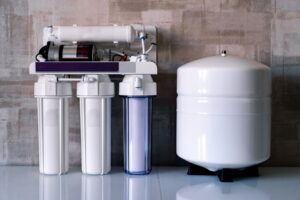
Reverse osmosis (RO) forces water through a semi-permeable membrane that filters out dissolved solids, heavy metals, PFAS, arsenic, chromium-6, nitrates, and a wide range of other contaminants. RO systems are the most thorough at-home filtration option available.
Most residential RO systems are installed as under-sink, point-of-use units serving the kitchen tap and, optionally, a dedicated drinking water line. Whole-house RO systems exist but are significantly more expensive and typically not necessary for drinking water quality goals.
What it addresses: PFAS, arsenic, chromium-6, lead, nitrates, dissolved solids, and most contaminants of concern for drinking water quality in LA.
What to know: RO systems produce some wastewater as part of the filtration process and filter water more slowly than unfiltered tap flow, which is why most systems include a storage tank. Filters require periodic replacement. A licensed plumber installs the system and connects it to the existing supply line under the sink.
Whole-House RO + Softener Combinations
For homeowners who want comprehensive treatment — soft water throughout the home and filtered drinking water at the tap — a combination of a whole-house softener and an under-sink RO unit is the most complete approach. The softener handles scale protection for appliances and plumbing; the RO handles drinking water quality.
This is also the most common setup A-1 installs for homeowners in the LA area who want to address both hard water and drinking water contaminants in a single solution.
Not sure which system is right for your home? A-1 Total Service Plumbing serves Los Angeles, La Habra, and Anaheim. We’ll assess your water and recommend the right fit.
