
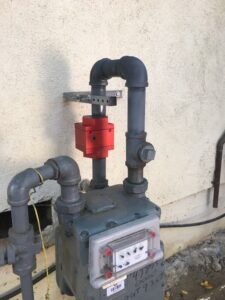
California doesn’t get to choose when the next earthquake hits. What homeowners can choose is whether their gas automatically shuts off when it does.
An earthquake shutoff valve — also called a seismic gas shutoff valve — is one of the most practical safety upgrades a Los Angeles homeowner can make. In some cases, it’s also legally required. Here’s what you need to know about how these valves work, when they’re required, and what installation looks like in LA, La Habra, and Anaheim.
What Is an Earthquake Shutoff Valve?
An earthquake shutoff valve is a device installed on your gas line, downstream of your utility meter, that automatically cuts off gas flow when it detects significant seismic activity. Most residential valves are designed to trigger at a magnitude of 5.4 or higher.
When an earthquake hits, gas pipes can crack or break. If gas continues to flow into a damaged structure, the risk of fire and explosion goes up dramatically — especially if no one is home to manually shut off the gas at the meter. A seismic shutoff valve handles this automatically, without you having to be there.
The Two Main Types
There are two types of earthquake shutoff valves commonly installed in Southern California:
- Seismic Gas Valve (SGV): Responds to the physical shaking of an earthquake. A steel ball sits on an internal pedestal inside the valve. When shaking exceeds the threshold, the ball dislodges and triggers the shutoff mechanism. This is the most common type for residential use.
- Excess Flow Valve (EFV): Activates when it detects a sudden, significant increase in gas flow — the kind that suggests a broken line. Where a seismic valve responds to motion, an EFV responds to the consequence of that motion.
Both types are LADBS-approved for residential installation. A licensed plumber can help you determine which is right for your property and gas line configuration.
Not sure which type of valve your home needs? A-1 Total Service Plumbing serves Los Angeles, La Habra, and Anaheim. Call us for a same-day assessment.
Is an Earthquake Shutoff Valve Required in Los Angeles?
This is where it gets specific, so it’s worth reading carefully.
City of Los Angeles
Within the City of Los Angeles, an approved seismic gas shutoff valve is required on any residential or commercial building that contains gas piping in the following situations:
- When the property is sold. The valve must be installed within 12 months of the sale agreement or close of escrow, and the buyer must notify LADBS in writing within 10 days of installation.
- When a building permit is issued for new construction (first issued on or after September 1, 1995).
- When a renovation or addition is made to an existing building with gas piping.
This requirement is documented in the LADBS 9A Report — the Residential Report that sellers must obtain as part of any real estate transaction in the City of LA. Failure to comply can result in a noncompliance fee on top of standard penalties.
La Habra and Anaheim
La Habra and Anaheim are located in Orange County, outside the City of Los Angeles jurisdiction. Requirements in these cities follow their own municipal codes rather than LADBS. Neither city currently mandates earthquake shutoff valves as a point-of-sale requirement in the same way the City of LA does, but requirements can change and vary by project type. If you’re selling a home or pulling a permit in La Habra or Anaheim, confirm the current requirement directly with the local building and safety department.
Regardless of whether it’s required, installation is strongly advisable in any Southern California home with natural gas service.
Why Install One Even If It’s Not Required?
The legal requirement is a floor, not a ceiling. The case for earthquake shutoff valves doesn’t start and end with compliance.
After major seismic events, fires caused by gas leaks have historically caused as much damage as the earthquake itself. The 1994 Northridge earthquake is the most prominent local example — dozens of fires broke out in the aftermath, many traced to ruptured gas lines. A shutoff valve doesn’t prevent an earthquake. It does prevent what often happens next.
Additional reasons homeowners in the A-1 service area choose to install proactively:
- Utility companies recommend manual gas shutoff after any significant earthquake, but many homeowners aren’t home when one hits. An automatic valve handles it without human intervention.
- Homeowners insurance policies increasingly note the presence or absence of seismic safety devices. Some carriers offer discounts for installation.
- If you’re planning to sell, installing now rather than at the point of sale removes it from the transaction checklist and gives you time to select the right valve and installer rather than rushing to close.
What Installation Looks Like
Earthquake shutoff valve installation is a gas line job. It must be performed by a contractor licensed by the State of California — not a handyman, and not a DIY project. The stakes are too high for gas line work to be done without the right license and permit.
The valve is installed on the gas line downstream of your utility meter, between the meter and the point where gas enters the building. Installation typically takes a few hours for a standard single-family home. A permit is required in most jurisdictions, and an inspection may follow.
Once installed, the valve requires no power and no regular maintenance. If it trips after an earthquake, it resets manually — no tools required for most residential models.
What to Look for in an Installer
- State of California contractor’s license in the appropriate classification (C-36 Plumbing or C-20 HVAC)
- Familiarity with LADBS-approved valve models and local permit requirements
- Experience across the specific jurisdiction — La Habra, Anaheim, and the City of LA each have their own permitting processes
A-1 Total Service Plumbing installs earthquake shutoff valves throughout Los Angeles, La Habra, and Anaheim. Licensed, permitted, and done right. Call us today.
Frequently Asked Questions
How much does earthquake shutoff valve installation cost?
Installation costs vary by valve type, pipe size, and jurisdiction. Expect a range roughly between $150 and $400 for a standard residential installation, including parts and labor. Getting a quote from a licensed plumber is the most reliable way to get an accurate number for your specific property.
Can I install one myself?
No. Gas line work requires a licensed contractor in California. An unlicensed installation on a gas line creates liability, may void your homeowner’s insurance coverage, and won’t pass inspection. It’s not worth the risk.
What happens after the valve trips?
After an earthquake triggers the valve, gas flow stops automatically. Once the shaking has stopped and you’ve confirmed there are no active leaks or damage to your gas lines, the valve can be reset manually. Most residential models have a simple reset mechanism that doesn’t require tools. If you’re unsure whether it’s safe to reset, call your gas utility or a licensed plumber before doing so.
Does it need maintenance?
Standard seismic shutoff valves are passive mechanical devices and do not require regular maintenance or an external power source. It’s good practice to visually check the valve periodically to confirm it hasn’t been accidentally triggered and that the gas supply is open.
Is a permit required for installation?
In most Southern California jurisdictions, yes. A permit is required, and the installation must be done by a licensed contractor. Your installer should handle the permitting process. If they don’t mention it, ask.
The Bottom Line
If you live in Los Angeles, La Habra, Anaheim, or anywhere in Southern California, an earthquake shutoff valve is a straightforward upgrade that costs relatively little and provides real protection. If you’re in the City of LA and planning to sell, it’s not optional.
A-1 Total Service Plumbing installs earthquake shutoff valves throughout our service area. Our licensed plumbers know the local permitting requirements for each city and can have the job done in a single visit.
Ready to protect your home? Call A-1 Total Service Plumbing for earthquake shutoff valve installation in Los Angeles, La Habra, and Anaheim. Same-day availability.
